
Dr. Nelson A. Mota, Department of Architecture, TU Delft.
Ukrainian Commentator: Igor Tyschenko, New Housing Policy Institute.


S6 LEARNING OBJECTIVES
At the end of this session, you will be able to:
1. Compare housing schemes taking account of different morphological and typological characteristics.
2. Evaluate the performance of dwelling communities taking into consideration the relation between social, economic and environmental factors.3. Formulate a design hypothesis to develop an inclusive dwelling community based on incrementality, typology mix and clustering.
Summary
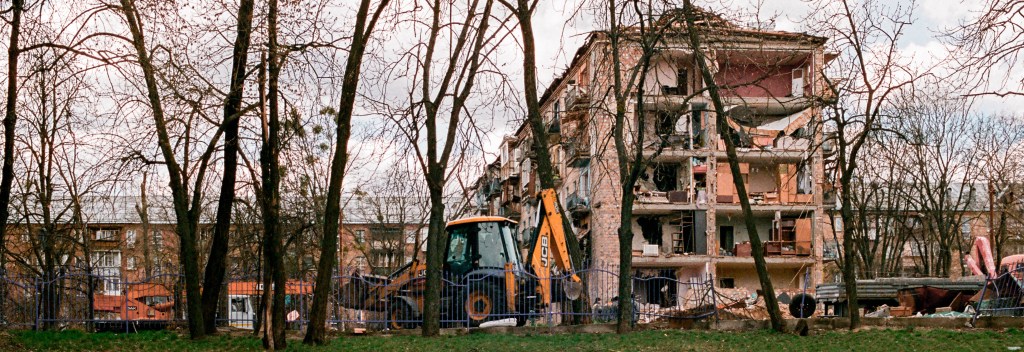
Building adequate housing is a pressing issue worldwide. With more than 80 million people forcibly displaced worldwide due to conflicts and natural disasters, improving post-disaster dwelling conditions is a critical issue for society.
This challenge cannot be solved with a one-size-fits-all approach. Every city, region and country demand their own housing models and prototypes. That’s why housing design needs to negotiate many aspects simultaneously to achieve sustainable urban environments and inclusive dwelling communities.
This module uncovers how social, economic and environmental factors are interrelated in the design of housing settlements. For this, the course dives into three key aspects that anyone involved in housing design should take into consideration: time, environment, and community. Each of these aspects will be examined through a specific design approach, respectively:
• Incrementality: how dwelling environments should be able to accommodate growth and change through time.
• Typology Mix: how design can be responsive to different patterns of inhabitation, aspirations and cultural backgrounds, creating inclusive dwelling environments.
• Clustering: what methods and strategies can shape the association of dwelling units in order to create meaningful communities.
In this module, each of these themes will be discussed in detail and exemplified by a new analytical approach to award-winning housing projects developed in different geopolitical contexts.
While each of these themes will examine aspects related to the design decision-making process, the module aims at addressing concerns that go beyond the design disciplines. Hence, regardless of background or level of expertise, this module will introduce learners to the core issues and challenges of housing design, using examples from different parts of the world. The concepts will be tested with a serious gaming exercise, based on role-playing in a neighbourhood development exercise.
Educational Methods
This module is based on the edX MOOC Global Housing Design, developed by TU Delft’s Faculty of Architecture and the Built Environment in collaboration with the Aga Khan Trust for Culture (AKTC). This MOOC offers a unique combination of videos, documentation of key case studies, animations, and feedback sessions.
Literature
- Frampton, Kenneth. 1975. “The Evolution of Housing Concepts 1870-1970.” Lotus International, no. 10: 24–33.
- Mota, Nelson. 2021. “Incremental Housing: A Short History of an Idea.” In The New Urban Condition: Criticism and Theory from Architecture and Urbanism, edited by Leandro Medrano, Luiz Recamán, and Tom Avermaete, 1st edition, 160–82. Abingdon, Oxon ; New York: Routledge.
- National Committee for Human Settlements, Government of Iran. 1976. “Habitat Bill of Rights.” Ekistics 42 (252): 302–8.
MOOC Global Housing Design
This is a ward winning MOOC organised by Nelson Mota, Dick van Gammeren, Frederique van Andel and Rohan Varma from the TU Delft. This MOOC is free (for a certificate, you need to pay a small fee).
Learn about the key design strategies required to develop adequate housing and inclusive dwelling environments for sustainable urban development. ACCESS THE MOOC HERE.
Resources (watch before the lecture).
- 1. Unpacking the concept of Incrementality: https://youtu.be/dDOCzFEBSXY
- 2. Unpacking the concept of Typology Mix:https://youtu.be/jJQ5eZKJHzY
- 3. Unpacking the concept of Clustering: https://youtu.be/HHSros9w4V0
Contributor
Nelson Mota is Associate Professor at Delft University of Technology. He holds a professional degree in Architecture (1998) and an advanced master on Architecture, Territory and Memory (2006) from the Department of Architecture at University of Coimbra (Portugal) and a PhD (2014) from Delft University of Technology. His doctoral dissertation “An Archaeology of the Ordinary. Rethinking the Architecture of Dwelling from CIAM to Siza” explores the relationship between vernacular social and spatial practices and the architecture of dwelling. Nelson is a founding partner of the architectural office comoco arquitectos, winner of the Portuguese National Prize for Architecture in Wood in 2013. He is the author of the book A Arquitectura do Quotidiano (The Architecture of the Everyday), published in 2010, and co-editor of Footprint #17: The ‘Bread & Butter’ of Architecture: Investigating Everyday Practices, published in 2015, Joelho #8: Ideas and Practices for the European City, published in 2017, and Footprint #24: The Architecture of Housing after the Neoliberal Turn, published in 2019. He is a regular architecture critic for C3 Magazine, and has published scholarly articles focused on housing issues and vernacular architecture in journals such as The Journal of the Society of Architectural Historians, The Journal of Architecture, Volume, DASH, OASE, Footprint, and Site Magazine. He member of the editorial board of the DASH book series and the academic journal Footprint.

Igor Tyshchenko is integrated urban management and sustainable development specialist at the New Housing Policy Institute, a team of researchers dedicated to changing the intellectual and institutional landscape of the housing sphere in Ukraine. Igor received a MSc in Urban Management at TU Berlin in 2020, previously worked in Ukraine in the field of urban research and policy analysis, and sustainable development. The New Housing Policy is a project aimed at researching the current situation with housing in Ukraine, developing new approaches and tools to respond to the housing question, and advocating new principles of building, using, and maintaining housing. We believe that the new housing strategy of Ukraine should not solely focus on protecting property rights of internally displaced people and return to the pre-war status quo but rather establish a long-term vision that would guarantee a just and sustainable living environment for communities.
The lecture
The presentations
Presentation by Dr Nelson Amorim Mota.
Presentation by Igor Tyschenko
 Tools for Post Conflict Urban Recovery